

In 1830 the United States had almost no railroad to speak of — a few dozen miles of track, more novelty than network. Thirty years later there were 30,000 miles. By 1890 there were more than 160,000. In a single working lifetime, the country stitched itself together with steel. Investment capital poured in from New York and London. New towns appeared because a line needed a water stop. Time zones were invented so the trains would not collide. Freight that had taken weeks by wagon was suddenly being moved in days, creating a national market that replaced smaller regional ones.
That build-out absorbed about 2.2% of U.S. GDP a year at its peak—the largest industrial capital bet of the 19th century. It was messy and overbuilt in places, but it also remade the economy and minted railroad “tycoons.” Today, we are running an even larger version of that experiment.
Economist Stijn van Nieuwerburgh’s Brookings work, as reported by the Wall Street Journal on September 23rd, estimates $10.3 trillion of spending on data centers and related AI infrastructure from 2025 to 2032 — about 3.6% of U.S. GDP per year. That is larger than the railroad boom. Highways, electrification, and the fiber boom that wired the internet were smaller still. This is the largest single-industry capital bet in American economic history.
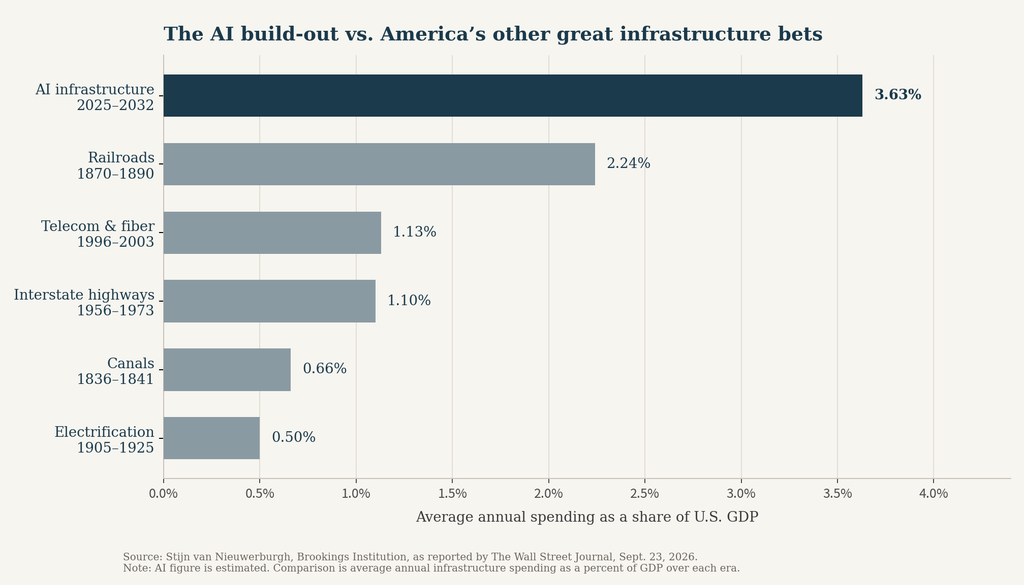
The companies writing the biggest checks are spending at a scale that, relative to the economy, has no American precedent outside the railroad era. The magnitude is both astonishing and unsettling. In July’s Follow the Capital, I wrote about the broader competition for investment dollars: grid upgrades, commodity stockpile rebuilding—including oil and rare earths—defense-industrial capacity such as drone manufacturing, and eventual reconstruction in the Gulf. The Wall Street Journal piece sharpens the point: AI infrastructure alone is large enough to affect inflation, labor markets, and bond yields.
So what can slow down this AI train?
In mid-September the executives of Anthropic, OpenAI, and xAI called for the pace of AI to slow — for the safety of humanity. Despite having the ability to control their own development pace, they are asking the U.S. government to regulate it. Forgive me for being suspicious, but I can’t remember the last time a business asked the government to regulate them more. Mature businesses almost never ask for more rules unless the rules raise costs for new competitors more than for themselves. Therefore, my conclusion is that they are not asking Washington to constrain them. They are asking it to constrain the next wave of AI models — and the models they are most nervous about are the cheaper open-source systems coming out of China, which are already good enough for most individuals and small businesses worldwide (did I mention cheaper?).
With the wave of competition coming, the businesses themselves can’t afford to slow down. Washington is not going to do it for them either. Regulation would slow the speed, but Congress is about to disappear into the midterm recess. After November 3rd, what is left of this Congress is a lame-duck session through mid-December. A Republican Party that loses the House (if that is how November goes) is not going to spend those weeks writing rules for frontier models. The next real window is sometime next spring. By then, given the leaps China is making, I doubt anyone in government proposes stepping on the brake.
It is possible that demand for AI falls or that supply constraints slow the pace. However, businesses are still expanding uses for AI, and most people are just scratching the surface. Supply constraints — chips, memory, electricians, transformers, interconnects — have already shown up, and so far the market has responded the way a market should: prices gap higher and capital shows up to add supply. That is why power equipment, copper, utilities, and the midstream of the data-center stack have been as much an AI trade as the model labs.
The most consequential brake may be a rising cost of capital. The Iran war is keeping energy prices elevated and stockpiles low, which is adding to inflation pressure. Readers will not be surprised that I expect inflation to remain sticky for the foreseeable future. Even if the war ended today, stockpiles around the world would still need to be replenished. Energy prices would likely fall, but not necessarily to their prewar levels. If inflation remains elevated, interest rates could grind higher and make money more expensive.
Near term, the path remains sticky inflation, higher rates, and more expensive money. Longer term, if AI delivers the productivity boost many are hoping for, that would help pull inflation down. That is probably a 2028–2030 question, not a 2026 one.
The measure I am watching
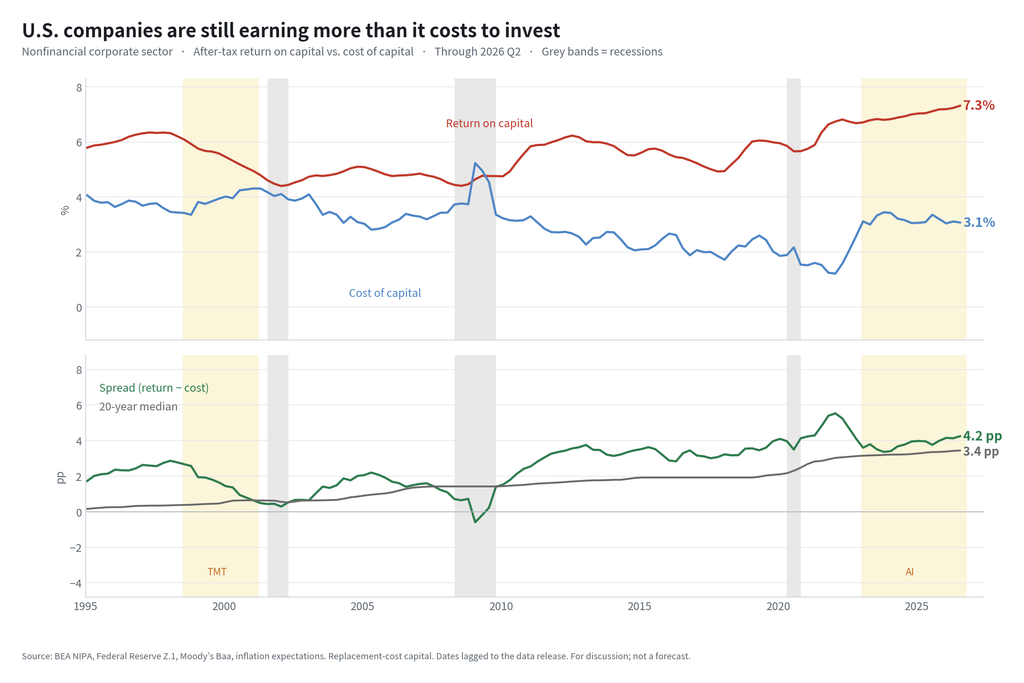
Every boom runs on a comparison. What does capital earn, and what does it cost to fund it? If the return is higher than the cost, money will continue to flow. That is a boom — and, past a point, a bubble. If the cost rises to meet the return (and then exceeds it), the flow of capital comes to a halt. That is a simple way to see how booms end. Not because the technology was fake, but because the last dollar cost more than it returned.
This is one measure investors should watch during the AI cycle: the gap between what U.S. companies earn on capital and what it costs them to fund that capital. This relationship is often described as a Wicksellian spread, after economist Knut Wicksell. A wide positive spread encourages investment because expected returns exceed financing costs; a narrowing or negative spread can slow capital formation.
The chart below shows that comparison. The top panel plots what companies earn on capital against their funding cost; the bottom panel shows the spread between the two. As of 2026 Q2, the spread is about 4.2 percentage points, still above its 20-year median of 3.4. That median offers a rough reference point—not a precise threshold—for judging when capital is becoming expensive relative to returns. Yellow highlights two periods that rhyme: the TMT boom and the current AI build-out. During the first, the spread was already narrowing before the recession arrived. Today, it remains above its historical norm, so the boom is still being fed. The key question is whether the spread begins to close from here, not whether it has already closed.
Governments are running the same experiment. They are issuing more debt into a higher-rate world on the theory that an AI productivity dividend will raise national earnings enough to pay for the debt. That can work, but it is also how late-cycle fiscal stories always sound.
The first domino may not be a tech stock
The same rise in the cost of money that would slow a data center in Virginia could hit a highly indebted government without reserve-currency privilege first. France is one of the clearest current candidates.
As I noted last month in Same Debt Problem, Different Flags: The U.S. and France, France is the cleanest political version of a problem a lot of governments now share. Debt just printed 119% of GDP, rating outlooks have started to slide, and the two leading presidential candidates have both proposed paths that, to put it mildly, do not make the French bond market’s job easier. The interest rate on that debt is now running above the growth rate of the economy. That is how trains derail.
If markets start to charge governments more for the same capital everyone is fighting for, that is not a separate story from AI. It is the same cost-of-capital brake, arriving first in a country that does not print the reserve currency.
The AI build-out is not a sideshow to that story. It is a bet by the U.S., China, and Europe that the returns from AI will help fund these massive deficits.
If they are right—later, not this year—the payoff could resemble the railroad build-out: messy, uneven, and ultimately productive. If the cost of money overtakes the expected return first, the next mile of AI track will not get laid. That has not happened yet. Higher rates have not closed the spread, investment capital is still flowing, and the build-out remains full steam ahead. But full steam ahead does not mean nothing can go wrong. Investors should watch the spread between returns and funding costs, along with capital flows, interest rates, and signs of stress in the banking system.
