Sequence of Returns Risk in Retirement: Why the Order of Market Returns Matters
One of the more consequential yet frequently misunderstood risks in retirement planning is sequence of returns risk. The issue is not the long-term average return a portfolio may earn; it is the order in which those returns occur, particularly in the years immediately surrounding the start of retirement.
Because the sequence of future returns cannot be known in advance, the risk is best addressed by building specific safeguards into the retirement income strategy rather than relying solely on historical averages.
How Sequence of Returns Risk Works
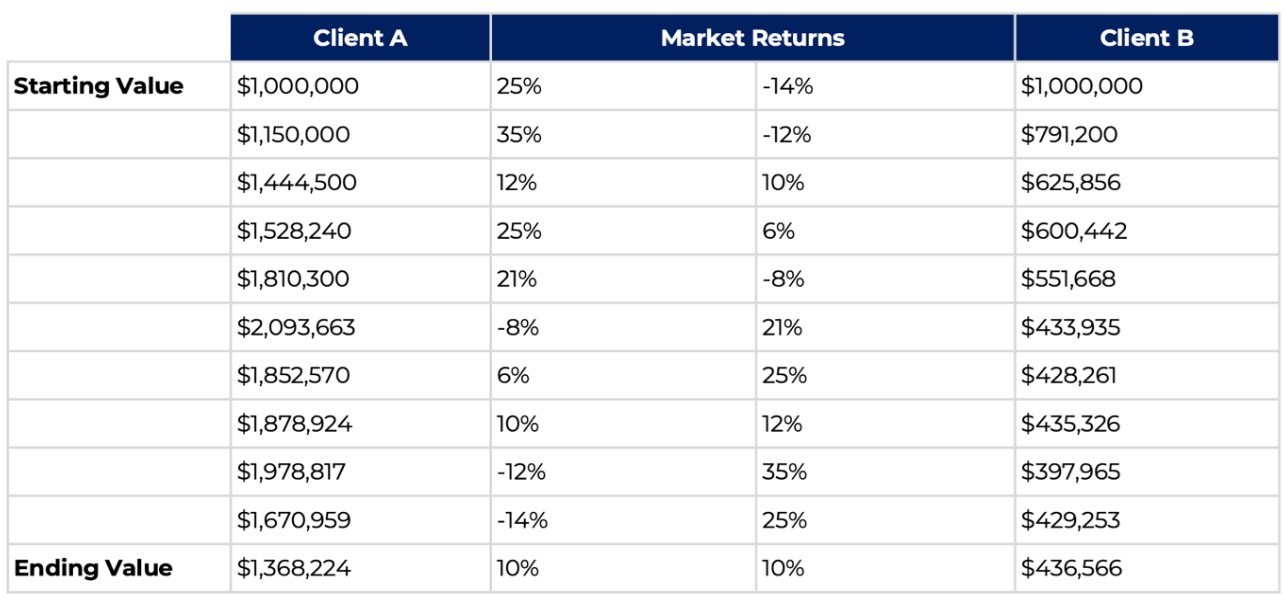
Consider two retirees who begin retirement with identical portfolio values and who ultimately experience the same average annual return over a multi-decade period. One encounters strong markets in the early years of retirement. The other experiences a meaningful decline shortly after withdrawals begin. Even though the long-term average return is identical, the second retiree can exhaust the portfolio much sooner.
Same initial portfolio value($1 million) and annual withdrawals ($80.000 per year). Same time-weighted rate of return, different dollar-weighted ending wealth. Average rates of return over a 10-year period, compound calculation.
The reason is mechanical: when withdrawals are taken while asset values are depressed, more shares must be sold to generate the same dollar amount of income. Fewer shares then remain to participate in any subsequent recovery. This dynamic is why the first several years of retirement often carry disproportionate weight in determining whether a portfolio lasts as intended.
Cash reserves, spending flexibility, and a structured withdrawal approach can therefore matter as much as the portfolio’s expected long-term return.
Why the Risk Increases Near and in Retirement
During the accumulation years, market declines are often viewed as opportunities to purchase assets at lower prices while contributions continue. Once retirement begins and systematic withdrawals replace contributions, the mathematics change. Large withdrawals taken during a period of negative returns can permanently reduce the portfolio’s capacity to recover and to sustain future income.
Approaches Commonly Used to Address the Risk
Several practical methods are frequently incorporated into retirement income planning:
Cash or short-term reserves — Maintaining roughly two to three years of anticipated spending in lower-volatility, liquid assets can reduce the need to sell equities during a market decline.
Asset allocation adjustments — Gradually shifting the balance between growth-oriented and more defensive holdings as retirement approaches can moderate the impact of early losses.
Spending flexibility — Establishing guidelines that allow temporary reductions in withdrawals during severe downturns can help preserve capital.
Layered income sources — Combining Social Security, any pension income, dividends, interest, and portfolio withdrawals can create a more stable overall cash-flow stream.
Regular plan reviews — Ongoing monitoring permits modest adjustments over time rather than abrupt changes made under market stress.
Sequence of returns risk cannot be eliminated, but it can be managed. The objective is not to avoid all market exposure; it is to construct a retirement income framework that can withstand an unfavorable sequence of returns without forcing irreversible decisions.
Individuals within approximately ten years of retirement, or those already in the early withdrawal phase, generally benefit from examining how their current portfolio and spending plan would perform under a range of return sequences. Building that analysis into the broader retirement strategy provides a clearer picture of sustainability and reduces reliance on favorable market timing.
Chris Krzus, CFP® is the founder and president of Wolfstone Wealth and a fee-only CERTIFIED FINANCIAL PLANNER® with more than two decades of experience. He began his career on the Chicago Board of Trade as a college kid, and has since specialized in comprehensive financial planning and investment management for busy and successful tech and business professionals and people in life transitions. Chris works with clients to bring clarity and confidence to their financial lives.
This is for informational purposes only and is not personalized advice. Please consult with your financial advisor or tax professional for guidance specific to your situation.
Don’t Miss a Post
The Wolfstone Perspective Delivered to Your Inbox
Get our quarterly market commentary, financial planning tips, and timely insights – Wolfstone’s Perspective on what the headlines could mean for your money.
No spam. Unsubscribe anytime. Your information is never shared or sold.